Crawl space encapsulation directly halts the chimney effect, which pulls warm, water-saturated Gulf Coast air upward through pier-and-beam foundations into living quarters. In Mobile County, relative humidity…
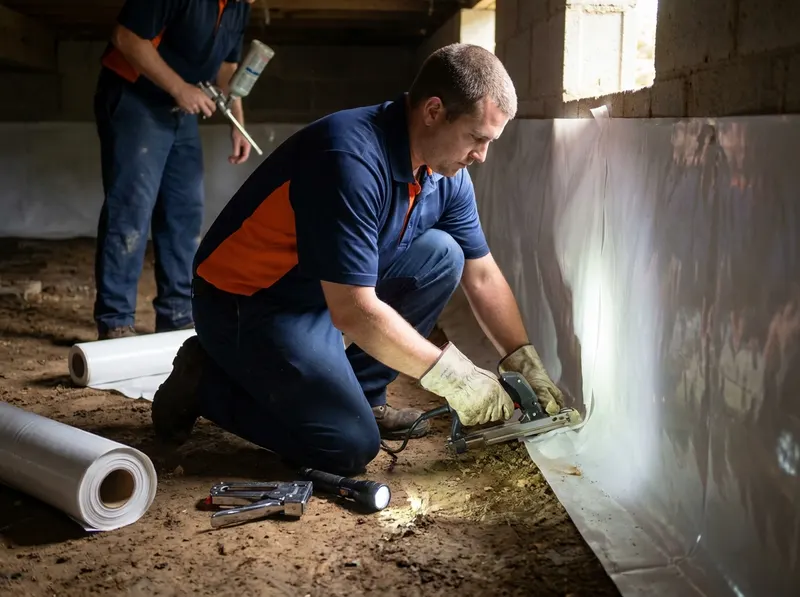
Crawl space encapsulation directly halts the chimney effect, which pulls warm, water-saturated Gulf Coast air upward through pier-and-beam foundations into living quarters. In Mobile County, relative humidity frequently exceeds 80% during summer months, causing open-vented crawl spaces in historic districts such as Midtown, Oakleigh, and Dauphin Way to sustain subfloor wood moisture equivalents above 20%. Sustained wood moisture at or above 20% triggers fungal rot (*Coniophora puteana*) and attracts Formosan subterranean termites (*Coptotermes formosanus*), which thrive on damp pine floor joists and sills. Encapsulation seals the subfloor perimeter with an impermeable polyethylene vapor barrier, isolating structural timbers from ground evaporation and exterior ambient humidity.
Selecting crawl space encapsulation requires evaluating structural conditions versus standard moisture-barrier alternatives. A standard 6-mil poly ground sheet laid loosely on dirt reduces simple upward evaporation by roughly 50%, but it leaves foundation vents open, allowing coastal humidity to condense against air-conditioned floor cavities. Full encapsulation seals vents, bonds a 12-to-20-mil reinforced liner to foundation piers, and conditions the envelope. The trade-off is mechanical reliance: fully sealed crawlspaces require either dedicated crawlspace dehumidifiers (such as a 70-to-98-pint per day unit) or conditioned supply air to regulate closed-boundary humidity below the 55% target. Property owners in Spring Hill or Ashland Place dealing with high water tables or sloped soil runoff may also need interior perimeter trenching and a 0.5-horsepower sump pump system to prevent hydrostatic water accumulation beneath the sealed barrier.
Regulatory standards in Alabama dictate clear boundaries for pest visibility during encapsulation. The Alabama Department of Agriculture and Industries requires a continuous 3-inch gap between the top edge of foundation-wall vapor barriers and the bottom of wood sill plates. This exposed masonry viewing strip allows pest technicians to detect subterranean termite mud tubes during annual inspections without slicing or pulling down barriers. Encapsulation work follows these steps:
1. Debris extraction: Removal of organic matter, fallen insulation, and old ground sheets to clear ground access across the foundation.
2. Drainage grading: Trenching low areas, installing French drain lines, and setting sealed sump basins where standing water collects.
3. Barrier anchoring: Rolling reinforced 12-to-20-mil polyethylene sheeting across floors, wrapping piers, mechanical fastening to foundation masonry, and sealing seams with waterproof acrylic bond tape.
4. Vent isolation: Sealing exterior foundation vents with solid closed-cell foam blocks to prevent humid ambient outdoor air transfer.
5. Atmospheric conditioning: Installing and calibrating dedicated crawlspace dehumidifiers to sustain subfloor relative humidity below 55% continuously.
Every job gets a firm, written price after a free on-site visit.
Tell us about your crawl space encapsulation job in Mobile and we'll send a clear, written quote, usually the same day.
 Valtrix Pest Control