Rodent and wildlife exclusion is an architectural barrier strategy that addresses roof rats (Rattus rattus), Norway rats, gray squirrels, and raccoons entering homes in Mobile County. In historic neighborhoods like the…
Rodent and wildlife exclusion is an architectural barrier strategy that addresses roof rats (Rattus rattus), Norway rats, gray squirrels, and raccoons entering homes in Mobile County. In historic neighborhoods like the Oakleigh Historic District, Dauphin Way Historic District, and Ashland Place, high-pitched roofs, cedar trim, and raised wood-pier foundations create natural entry pathways. Commensal rodents require an aperture of only 0.25 to 0.5 inches to enter living quarters or attic floor joists. Rather than relying on continuous chemical bait applications, which present secondary toxicity hazards to domestic pets and indoor air quality, exclusion implements non-corrosive, physical blockades.
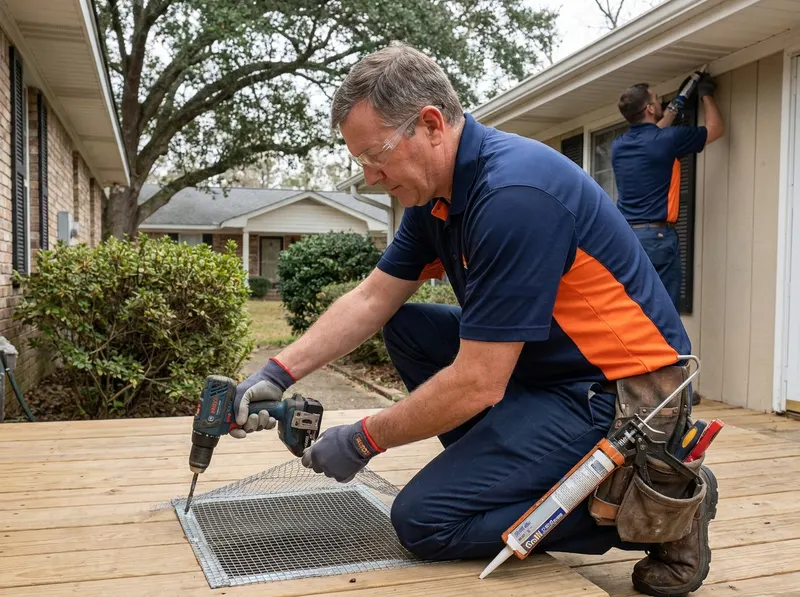
Technicians secure building envelopes by mounting 1/4-inch 16-gauge galvanized hardware cloth over crawl space vent grates and wrapping rake-edge fascia intersections. In brick-and-timber residences throughout Spring Hill, Midtown, and Llanfair, massive live oak canopies drop limbs onto shingle lines, granting roof rats direct runways to soffit corners and frieze board seams. Unsealed construction gaps along roof flashing and unbaffled ridge vents allow wildlife to nest directly above ceiling plaster. Sealing these breaches stops attic electrical wire gnawing and structural timber degradation without leaving decomposing carcasses inside wall cavities.
Structures in Cottage Hill, Bertha Hills, and Hannon Park frequently utilize slab foundations with ground-level utility penetrations. Air conditioning line sets, gas meters, and unshielded dryer vents serve as standard burrowing vectors. Exclusion measures employ polyurethane elastomeric sealants reinforced with stainless steel wool to eliminate gnaw-through potential. Step one involves identifying active entry trails, step two establishes positive one-way exit funnels so existing animals clear out, and step three binds heavy-gauge steel barriers over every primary and secondary architectural vulnerability. The process stops the recurring financial drain of open-ended trapping programs by targeting the structural shell permanently.
Every job gets a firm, written price after a free on-site visit.
Tell us about your rodent and wildlife exclusion job in Mobile and we'll send a clear, written quote, usually the same day.
 Valtrix Pest Control