Formosan subterranean termites differ fundamentally from native subterranean species due to their massive colony sizes, which frequently exceed several million individuals, and their capacity to build secondary carton…
Formosan subterranean termites differ fundamentally from native subterranean species due to their massive colony sizes, which frequently exceed several million individuals, and their capacity to build secondary carton nests inside wall voids without maintaining ground contact. In Mobile neighborhoods characterized by high water tables and historic wood framing, such as Oakleigh Historic District, Dauphin Way Historic District, and Ashland Place, crawlspace ventilation and old-growth pine provide optimal moisture and cellulose reservoirs. Concrete slab foundations common in Cottage Hill, Llanfair, and Bertha Hills present separate vulnerabilities where utility conduits and expansion joints offer hidden entry paths through 1/32-inch foundation gaps.
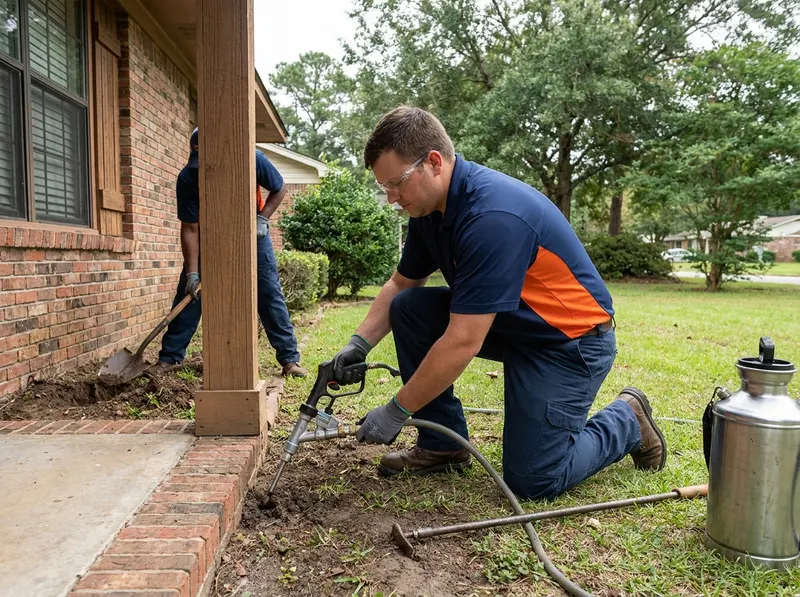
Selecting between comprehensive liquid perimeter barriers and inground baiting networks depends directly on foundation architecture and exterior surface access. Continuous non-repellent liquid applications require digging a 6-inch by 6-inch trench along all exterior foundation walls and rod-injecting termiticide into the soil, creating an undetectable lethal transfer zone. When properties in Midtown or Spring Hill feature wrap-around masonry porches, attached carports, or extensive exterior brick pavers, drilling through finished hardscapes is required to maintain barrier continuity; in these situations, bait matrix systems serve as the cleaner alternative by intercepting subterranean foraging paths at 10-to-15-foot perimeter intervals without drilling structural masonry.
Formosan control operations in coastal Alabama demand systematic site preparation and strict moisture reduction. 1. Technicians conduct a multi-point acoustic and moisture meter scan across interior baseboards, plumbing chases, and attic trusses. 2. Exterior perimeters are prepared by clearing mulch and groundcover 12 inches away from the foundation line. 3. Soil trenching or station core-drilling proceeds around the full structural footprint, establishing either continuous protective chemical envelopes or active bait matrices. 4. Annual monitoring cycles track consumption rates and detect potential carton nesting sites behind plaster and drywall, neutralizing colony pressure before warm-season May and June swarming periods.
Every job gets a firm, written price after a free on-site visit.
Tell us about your formosan termite protection job in Mobile and we'll send a clear, written quote, usually the same day.
 Valtrix Pest Control